HERALDRY
The Birth of a Coat of Arms
HERALDRY
The Birth of a Coat of Arms
An earthquake, the fragility of the Ianuarii Scaricamazza Palace in Castagneto, and the disappearance of an old shield gave rise to a conviction: before it is too late, the past must be told.
In 1940, my great-grandfather, Lamberto, commissioned a heraldic study of the family.
The study attributed a coat of arms to the Scaricamazza which, many years later, my own research would trace to arms of the Milanese di Mazoli family, documented in the fourteenth century.
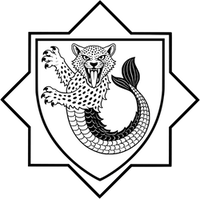
As a heraldist, I sought a single, simple and isolated figure, capable of synthesising a history without turning the shield into a collection of symbols; the choice fell on the sea-leopard.
The leopard recalls the family’s foundational narrative, linked to Norman Sicily; its aquatic nature evokes the territory, historically marshy and surrounded by mountains.
The colours follow the same principle: the red field recalls the origins of heraldry, in whose earliest phase it was the predominant colour; gold and black, meanwhile, allow the leopard to be depicted proper, following a practice characteristic of Italian heraldry and combining realism with heraldic synthesis.
The arms may therefore be blazoned: Gules, a sea-leopard rampant Or, spotted and scaled Sable, armed of the like.
In the leopard I also recognised something of the family itself: a history of visibility and oblivion, violence and dignity, departures and individualism. It is a solitary and elusive animal; at the same time, it escapes the gaze and yet captures it.
The arms were thus born through synthesis: origins, territory and family history concentrated into a single heraldic creature.
The sea-leopard was not chosen because a meaning could be assigned to it: it was chosen because, without ceasing to be a single figure, it could contain many.