We dedicate ourselves to the study of heraldry.
According to the Encyclopædia Britannica, “heraldry [is] the science and the art that deal with the use, display, and regulation of hereditary symbols employed to distinguish individuals, armies, institutions, and corporations. Those symbols, which originated as identification devices on flags and shields, are called armorial bearings. Strictly defined, heraldry denotes that which pertains to the office and duty of a herald; that part of his work dealing with armorial bearings is properly termed armory. But in general usage heraldry has come to mean the same as armory.”
It is a complex discipline, we know that. So why should we engage with the vast and intricate history of the Middle Ages, taking time away from what truly interests us—heraldry itself? It’s a legitimate doubt.
Let me explain the dilemma.
All of us—whether artisans or laborers, princes or bourgeois—have the right to bear a coat of arms, as we have previously recalled and demonstrated. However, we cannot deny that many of the armoiries that come to mind belonged to nobles or were, and still are, used to represent their kingdoms, principalities, marquisates, duchies, and counties.
Here lies the first issue: territories and their administrations are ever-changing, and their names are not always precise. A second difficulty: often, both historical and contemporary figures—for instance, consider a young European born in the year 2000 with blue blood, or at least something slightly greenish—claim titles that are tied to medieval institutions, lands, and legal traditions. It seems there is no way out: the Middle Ages haunt us.

Let’s reflect on how to approach the problem. Imagine this scenario: we are passionate about heraldry, we recognize countless coats of arms, we have an excellent memory, and we consider ourselves near-experts. For a moment, we indulge in an illusion: “Literature and religion don’t exist; knowing about some King Arthur or Saint Michael isn’t important.” Naturally, we add: “Understanding the figurative arts, Christian iconography, and iconology is of no use. Reading statistical data on lions and eagles? Surely you must be joking!” We recognize many coats of arms, and we believe that’s enough. We tell ourselves: “Three gold leopards on a red field? That’s England under the Plantagenets! A lion with an axe? Eirik II of Norway.”
Very well. Now, let’s imagine a curious child eager to ask questions.
“Who decided that the United Kingdom is a kingdom and not a grand duchy like Luxembourg?” We might not know the answer, and that would not be a tragedy.
“Why did Charles inherit the crown and not his older sister? Can Princess Margaret use the royal arms of England? And what about the Prince of Wales?”
We answer the last question with cunning: “Because he’s the firstborn!”
The child does not give up: “Are these universal rules? Since when?”
Now things get complicated.
The teenager notices a Scandinavian friend’s passport. “Why does that axe appear in Norway’s coat of arms?”
Be careful, because vague or rhetorical answers like “it symbolizes strength and valor” won’t satisfy him.
Again, standing before the window of a numismatic shop in Milan:
“Why does a Milanese gold coin from the 1500s feature the Biscione, the heraldic emblem of the Visconti, at a time when their family had already disappeared, alongside the lion and castle of the Kingdom of Castile and León? Is that BiscioneVisconti’s, Sforza’s, the Duchy’s, or the city of Milan’s?”
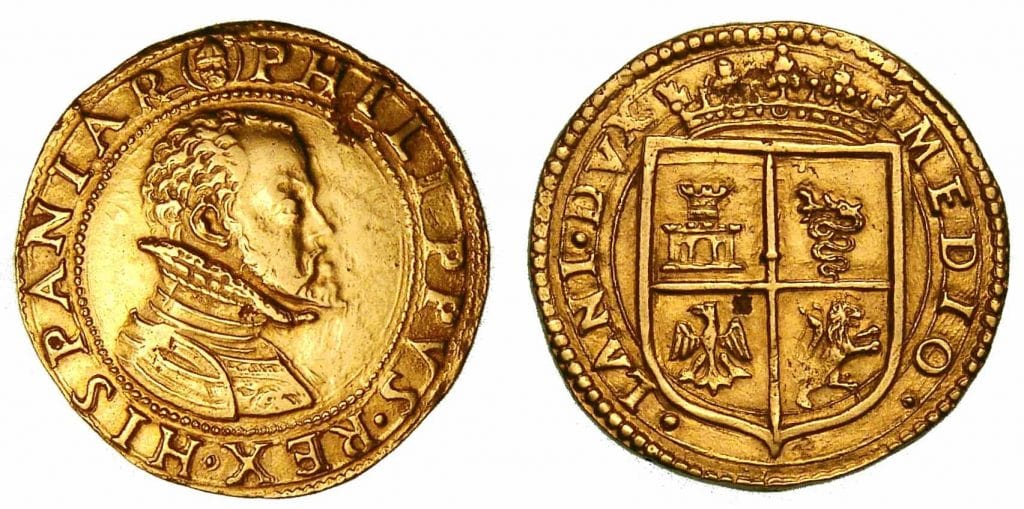
Have I convinced you? There is a solution, and it does not involve murdering the child—it is revision.
Mine will be a simple overview. I hope it will be helpful; it certainly was for me.
On this occasion, I will focus solely on history. Let’s begin.
Once upon a time…